Thursday, 9 March 2017

Portugal: Terrible timing in Porto

Lent in Porto


Growing up as a Catholic in the UK, I combined an early appreciation of the joys of the local pub, with a respect for people like my parents, who had the willpower to abstain completely during Lent.

Now that I have retired and reached the age of 60, I thought it a good time to finally emulate them.  Initially the timing was great - not many inviting pubs in the Rwenzori Mountains, and Zanzibar is a Muslim country.  But we are now in Portugal and the temptations are multiplying.


Vinho Verde:  Portugal's "session wine"


A good Vinho Verde is fresh, fruity, slightly effervescent, and absolutely delicious.  It is also relatively light in alcohol (8.5% to 11%), so you can guzzle more of it before you start to regret it.

Jealousy is not an emotion that I am proud of, but I have to confess a certain envy, as I watched Michele enjoying suitable refreshment as we admired the view over the river Douro


The "Red Nectar"


Porto is of course named after the delicious fortified wine invented by the English (Editor: are you sure it's not the other way around?).

In this city there are a million ways to enjoy the stuff, but I cannot take advantage of any.


The bookshop that charges admission


All over North America book stores are being forced to close their doors.  Maybe they need to take a page out of this store's book and charge admission.  People line up for the privilege of buying a ticket just to go and see the store.


Mind you it's easier to charge admission, when you helped to inspire JK Rowling's vision of Hogwarts, and the interior looks like this:


Paris it ain't


Porto fully deserves its Unesco World Heritage designation:


But if you are looking for the sort of picture postcard perfection that you associate with places like York and the centre of Paris, then you might be disappointed.  This place definitely has a comfortable, lived in feel, that I happen to find appealing.


Saturday, 4 March 2017

Chumbe Island: Surviving Jellyfish to see a Hawksbill Turtle

We have just come back from an overnight stay at the beautiful Chumbe Island Coral Park resort.  This is an environmental project run by two expatriates, the German founder, Sibylle Riedmiller and a young Canadian business graduate from Ryerson University.  The hope is that one day it will be run by local staff.  In the meantime the project aims to maximise the economic benefit to the local community - employing 45 people for a resort that has just 7 rooms.


Eco- tourism

Management choices attempt, wherever possible, to limit the environmental impact of the resort.

Each cabin is built on top of a 10,000 litre cistern for storing rainwater.  The island is currently experiencing a drought.  Nevertheless there was plenty of water for our showers.


Readers of this blog will know how much I appreciate flush toilets.  I was a little sceptical when I heard about the composting toilets.  Turns out that I should have been more open minded.


The bark mulch that was provided, did a fantastic job of keeping the place smelling nice.


Jellyfish and Turtles

On the snorkelling trip, we all got stung by the clouds of microscopic jellyfish in the water.  The stings were mild - not as bad as walking through a patch of nettles.  Afterwards, the stings affected each person differently.  One poor girl had a miserable night of it as her body reacted badly:


Michele was feeling the stings as much as anybody, but she had come to the island to see a turtle.  Our guide swum fast in pursuit of the elusive turtle.  Michele, not normally known for her love of water sports, kept up with no complaint.  Eventually we were rewarded with a sighting of the turtle.


Personally, I would have given up the chase as a lost cause if it was not for Michele.  As it was, by the time we actually found it, we were the only tourists still in the water.  We were able to follow the turtle as it swam around the reef.  Our presence did not seem to disconcert the turtle (Editor:  how would you know?).  Anyway after about ten minutes we decided that we should leave the poor creature alone.


Development: Different Takes from two impressive Muzungu women - (Editor's warning, long and academic)

"Muzungu" is the word used in East Africa to refer to white people - similar to the way the word "gringo" is used in Latin America.  Last night Michele and I were lucky enough to meet two impressive women able to share insights based on practical experience in one case, and academic research in the other.


Take 1:  A project that seems to tick all the boxes

By definition it is almost impossible to find a project that ticks all the boxes in terms of impact and long term viability.  In a typical scenario, a dynamic big hearted individual or group, does more than walk to the other side of the street when confronted by abject misery.  The problem, of course, is what happens when the founders are no longer around.  This is the toughest box to tick when it comes to building a sustainable project.

Finally, after visiting countries in Latin America, East and North Africa, we have stumbled on a project that seems to tick all the boxes for impact and long term viability:


This project is the Hands Across Borders charitable society's Jambiani Tourism Training Institute ("JTTI").   One of the ironies of Zanzibar tourism is that so many of the staff come from the mainland.  The reason for this is that in Zanzibar the government schools fail completely when it comes to imparting the rudiments of arithmetic and the English language.  Students graduate high school not knowing their times table.  Whatever the reasons for this situation, the result is that much of the economic benefit of the islands' hotels flows overseas. 

The JTTI addresses this problem head on.  Tuition is free, and places are reserved for students so poor that they cannot afford the fees at other colleges.  Students are also provided with the nutrition they need to study effectively.  Graduates can look forward to gainful employment with one of the islands' many hotels.


The "secret sauce" of this project is the adjacent guesthouse property (see the Air BnB description), which should generate the necessary funding for the indefinite future.

To understand how this was achieved it is necessary to know a little bit about the ups and downs that Pat, and her husband Dr Alistair Pirie, have had to go through along the way. 

No Good Deed Goes Unpunished

One amazing part of the story is that prominent members of the local Jambiani community did not just twist Pat and Alistair's arms to start the project, they also came up with three quarters of an acre of prime beach front property to locate the project on.

As Jambiani has developed into a popular tourist destination, the value of this land endowment has increased exponentially.

The project's prospects  looked even brighter when the founders won World Bank funding for the construction of a guesthouse to generate an income for the vocational school.

However this a part of the world where good deeds are frequently punished.  Even though the money from the World Bank came through, and even though the builder was paid, the construction was left incomplete.  The matter is now before the courts, and may well be resolved by the year 2050.

No Evil Deed Goes Unrewarded

During Zanzibar's 1964 Revolution, thousands of the ruling Arab class were massacred. The survivors escaped to places like the Gulf, with little more than the shirts on their backs.  However many of them have subsequently prospered.  In many cases, through a mixture of ability and hard work, they have been able to ride the Gulf region's boom, to restore their family fortunes.

Incredibly, given the history, they still feel an affinity for Zanzibar and have set up a foundation for supporting worthwhile projects on the islands.  Pat and Alistair obtained the funding needed to complete the construction of the guesthouse, from this foundation.  The guesthouse is now open for business, and training at the JTTI will resume once sufficient funding has been generated by the guesthouse.


Take 2:  Re writing the accepted Chinese African narrative

The academic at our table was Dr Lucy Corkin, who earned her PhD from the London School of Oriental and African Studies by writing about the relationship between the Chinese and Angolan governments.  That work has been repackaged as a book:


The accepted Western narrative on China's role in Africa, is that a monolithic China plays the various African regimes for dupes, obtaining vast resources from corrupt governments in return for punitive loans and dodgy infrastructure.  In other words, they are repeating the trick of the early Dutch settlers who managed to buy Manhattan Island for the price of a bunch of trinkets.  Lucy, who hails from South Africa and speaks Mandarin, spent three years investigating this narrative using Angola as a case study.  

In the case of Angola, she found that country's elite had used the relationship with the Chinese to bolster their position in an astute manner.  They were far from being the dupes portrayed in the standard Western narrative.  Of course whether the man in the street derived any benefit from the relationship is a different issue - one that she does not investigate in her book.

Using Lucy's book as a pulpit for my own two cents on the subject....

What I like about this book's thesis is that it is a reminder of the "agency" perspective.  The agency perspective attempts to navigate between blaming the victim on the one hand, and giving a free pass to every murderous kleptocratic dictator on the other.  

From an agency perspective the outcome of any injustice is a function of two things:  first, the original injustice, second the response to that injustice.  In other words the consequences of an injustice are not necessarily predetermined.  They are also affected by the actions of those in a position to dictate the response to that injustice.

Nelson Mandela's heroic conduct is illustrative.  After the terrible injustices that he had endured, nobody would have been surprised if he had become just another brutal dictator pursuing a policy of violent retribution and personal enrichment.  He chose another path.

The contrast between modern day Chile and Argentina provides another example pointing in the same direction.  Both countries endured the rule of violent dictatorships backed by the U.S. in the 1980s.  Given this common legacy it is interesting to see the difference between the two countries now.  Chile is the richest country in South America, while Argentina is a basket case that continues to lurch from one crisis to the next.

The important thing about the agency perspective is that it asserts that the actions of an evil dictator like Idi Amin are not pre- determined, and we should not give him a free pass for all the terrible things that he did.

In 2014, an Amazon reviewer of Ruth First's book, "The Barrel of a Gun" using language that prefigured Trump observed:

The book covers Africa's Big Man syndrome, which is again rearing its ugly head.  The misappropriation and outright theft of assets and resources is sad.  Maybe the time has come to prosecute those in developed nations who make it all possible.

Am I the only person who finds these sanctimonious sentiments written by a non African irritatingly patronising? They imply that Africans themselves have no agency.

Far more bracing are the words of the great Nigerian novelist Chinua Achebe.  In his 1983 book "The Trouble with Nigeria", he wrote:

"The trouble with Nigeria is simply and squarely a failure of leadership.  There is nothing wrong with the Nigerian character.  There is nothing wrong with the Nigerian land or climate or water or air or anything else.  The Nigerian problem is the unwillingness or inability of its leaders to rise to the responsibility, to the challenge of personal example which are the hallmarks of true leadership" 

Two weeks ago, a Nigerian newspaper, The Daily Trust, published a column where the writer observed that Achebe's trenchant criticisms are just as valid today as they were in 1983.


Monday, 27 February 2017

Dreaming in Zanzibari

We are born with the ability to day dream, but before too long that ability is lost to the demands of complexity and the pursuit of distraction.  I could not post this blog were it not for the accumulation of decades of complex coding.  

But even when we have the choice, we turn our back on day dreaming.  People lucky enough to retire with health and wealth, feel the need to make a job of it.  Communities are built around acres of fertile farmland which is soon drowned in fertiliser and pesticide, and kept green by draining the water table.  People grow exasperated chasing a little white ball around, as it refuses to go in the right direction.  Finally, they drown their sorrows at the 19th hole.

Life in Zanzibar is not perfect.  Its heritage is built on the Arab slave trade. There are all the opportunities for corruption and incompetence that you can expect of any regime that styles itself as a "Revolutionary Government".  Garbage is accumulating, aquifers are draining and the coral reefs are tenuous.  Education is far from adequate.....

But....but...but


Zanzibaris seem content.  Life (for the men!) revolves around the three pillars of prayer, fishing and sleeping - no alcohol, no tv, no internet.   In the meantime they have enough to eat, nature provides......Salaam-Aleikum.


Life at the Top and Bottom of the Food Chain in Ruaha

Top of the Food Chain

First clue we got that something was up, was the sight of vultures in the trees:


We speculated that there must be something dead being guarded by a predator.  That supposition was confirmed by the stench and sight of a dead giraffe.


And sure enough it was being guarded by its nemesis


and family


Bottom of the Food Chain

Life at the other end is not quite so dramatic


The beetle on the right is a guy.  He has his head and hands in the dirt, while he is pushing the ball of dung with his back legs.  The other one is a woman.  She is catching a free ride because she has very important work, don't you know.  She will soon be laying eggs in the middle of the ball of dung.  I would like to say I know how he feels, but I wouldn't dare!


Some signs you are just meant to obey


"I had a tent in Africa"

Mdonya Old River Camp brought out Michele's inner Karen Blixen


The bed was super comfortable


The tent even had an en suite bathroom complete with flush toilet and shower.  The shower water was heated by solar panels.


The only glitch was that a thirsty elephant had raided the water tank, thereby knocking out the supply of water to the tents.

Delicious food served with all the decorum of Downtown  Abbey, completed the sense of bygone elegance


- oddly enhanced by an audience of Impalas


Ruminating on Family Folklore in Ruaha

Myth and Memory in Ruaha

I was seven when our family left Tanganyika, uprooted by a country that had no further use for a bank that called itself Dominion, Colonial, and Overseas.  The wellspring of the particular joys, unique to those times, has been elusive ever since.   Body armour was strapped on to withstand the 24 7 scrutiny of boarding school, and to survive in what is often referred to as the "real world".  Weighed down by all the armour, it has been hard to find the way back to the source of all those memories.

That changed when we visited Ruaha National Park.  One look at the map brought back names rich in mythic family connotation:  Iringa, Mbeya, and Tukuyo (not shown).


Ever since our Ruaha safari, flickering fragments have been floating across my flatscreen of family folklore.  

Grandma Kitty made up in will power what she lacked in stature.  Determined to escape the dreariness of de Valera's time with all its shades of depression, divinity, and damnation, she qualified as a nurse in Protestant Belfast.  As a midwife, she cycled with umpunity through the slums of the Protestant Shankhill Road, delivering more babies in a week, than most doctors deliver in a month.  

Adventure beckoned in the shape of an advertisement for a job with the British Colonial Service in Tanganyika in the early Fifties.  She found herself working as a District Nurse visiting the aforementioned Mbeya, Tukuyo and Iringa.  Living all on her own, it was explained that she needed to employ servants, as there was a shortage of jobs in the area.  In order to cross a flooding river without contaminating her nursing bag, she took a piggy back ride from an ancient tribesman.

For somebody who grew up waiting until she was old enough to in inherit her older brother's bicycle, she marvelled at the fact that she could actually afford a Vauxhall Velox:


At a dance in Dar es Salaam, her well intentioned friend warned her from dancing with Grandpa Michael - judged to be "far too much of a Pukka British Sahib" for a feisty young Irish woman like Kitty.  Fortunately she decided to make up her own mind.

As bank manager in Musoma, Michael defied Head Office and dispursed funds so that the local farmers could plant the next season's sysal crop.  As a boy loving anything to do with guns, my proudest moment was watching my father wear a Berretta pistol as he escorted the monthly gold shipment to the waiting plane.  The hero worship only grew when it fell to Dad, as the resident Bwana, to wield an axe against a deadly Black Mamba snake.

We would waken to the sound of fishermen bickering over the morning's catch on the shores of Lake Victoria, at the bottom of our garden.  Mum's favourite gooseberry patch eventually became a hippopotamus wallow.

At Christmas, Santa Claus would make a grand appearance arriving on a motor boat.  One year we were given inflatable floaties for Christmas.  Fear of bilharzia kept us out of the lake.  We had to settle for using the floaties in the bath, which was a very poor substitute.  Our frustration was only slightly assuaged by the warning that if we caught bilharzia, we would need twenty injections in our stomach.  Of course watching our neighbors' boys allowed to go water skiing on the lake, just rubbed salt into the wound. 


Wednesday, 22 February 2017

Mainlining Imodium on the Mountains of the Moon

Basic Preoccupations

The Rwenzori Mountains are Uganda's answer to Tanzania's Kilimanjaro - mountains so high that they support a (albeit shrinking) glacier on the Equator.  To early explorers the Rwenzori Mountains appeared so unearthly, that they called them "The Mountains of the Moon".  

Despite the Western decadence of porters, cooks, and guides, life on the climb, was soon reduced to basic preoccupations: toilets, snoring and germs.

Toilets

It should be stressed at the outset that our hosts at Rwenzori Trekking Services literally left no stone unturned in their efforts to provide us with a safe and enjoyable adventure.  Anything that could be done to improve our trip - they did it.

A typical latrine configuration involved a malodorous pit topped by a plank platform.  Set into the platform was a hole about the size of a pocket paperback book (which incidentally was always worth bringing to such occasions, due to the sporadic toilet paper supply situation).  People blessed with experience and strong core muscles, could squat, and simultaneously aim both streams through the narrow target zone.  Normal people, i.e me, had to just collapse onto the rather slimy wood and aim their various streams as best they could.

However basic these arrangements may sound, they were positively luxurious compared to being caught short in the middle of a day's hiking.  The Rwenzori Mountains are truly a pristine wilderness.  In the circumstances, common ecological courtesy required that you use a little cigarette lighter to set fire to any toilet paper you may have used.  Logically, you would only put yourself through this ordeal if you had dysentery, in which case it was not obvious to me, how the paper would ever catch fire.  Put it this way, it was an experiment that I was not really ready to try.  Hence Mainlining Imodium on the Mountains of the Moon.  By the time I was finished, the Imodium had sucked any last drop of fluid out of my gut.  Any food being consumed was headed for a one way cul de sac as tight and dry as any security vault.  You won't find this survival strategy mentioned in any self respecting adventure handbook, but it worked for me.

The next problem was keeping your hands clean - we got through a lot of hand sanitizer.  On a good day, you were provided with soap or water.  This picture shows a red letter day...both soap and water.....


Snoring

Compared to camping, the huts we slept in were positively luxurious - although "luxury" in this context is very much a relative concept.


That shiny insulating material that you can see in the hut wall crackled and magnified the sound of any wind.  When gales blew down from the glacier, it sounded like the hut was about to go airborne.

Space was at a premium.  Unfortunately for J, a very fit 50 year old yoga instructress, she often seemed to end up in the bunk below mine.  This was a double whammy, as she had to watch in dumbfounded amazement as I scattered my kit all over the floor around her bunk.  Even worse, on my frequent nocturnal toilet journeys, I climbed in and out of the bunk with all the grace of a drunken walrus.  Luckily she already had four kids of her own, so an extra one on the mountain, did not seem to faze her.

By some sort of karmic justice, the two speed demons on our trip (C, 34 years old, and P, 43 years old) also happened to be the worst snorers.  It being very cold at night, we were in our sleeping bags for nearly twelve hours at a time.  By the end, we were all quite the connoisseurs of our friends' every titanic grunt and whistle.  It was not the volume that killed you, it was the irregularity.  Trains rumbling over tracks, "clickety clack" can be quite soporific because of the predictable pattern of the clicks and clacks.  Here it was the suspense that got to you.  You knew the ground was about to shake, you just could not predict exactly when.  C was so impressed with his peer's snoring, that he actually taped P, so that he could prove to his own girlfriend that he had serious competition in that department.

To be fair to P and C, they did once exile themselves to their own tent.   This would have worked great, except that the tent was on a slope.  Every so often they had to drag their sleeping bags back up to the top of the tent, before inevitably starting to roll down just as they started to fall asleep.

Germs

Ever since the SARS scare I have been right up there, when it comes to germs and shaking hands.  In my last job, we often met with people from Toronto.  Not wanting to contract some dread Ontario flu, I would - once the formal handshake round had been completed - slide off to the bathroom to wash my hands.

Given my mortal fear of mountain toilet arrangements, this caution nearly became an obsession on the trip.  Between bogs and rocks, the terrain was "challenging".  The guides soon figured out that I was the designated "weakest link" and needed a helping hand over many an obstacle.  I felt like an eighty nine year old woman being helped into her seat on the Number 7 bus, except that it happened thousands of times a day.  If I had received a dollar for every time I needed to say "thank you", I would be a rich man by now.  Needless to say the porters' hygiene was impeccable and the turmoil was all in my own head. 

Margherita Peak: if you cannot climb it, drink it

This rather weak pun, owes its provenance to a popular t-shirt in these parts:


At 5,100 metres Margherita (named by a pizza loving explorer, the Duke of Abruzzo) is the highest peak in the Rwenzoris and the third highest peak, after Kilimanjaro and Mount Kenya, in Africa.

As a climb it was never going to be easy, given the altitude and the ground to be covered on Summit Day.  Unfortunately, the retreat of the glacier, has made a real challenge of Summit Day.  Only two of our party (the aforementioned snorers) completed the ascent and descent in the 9 hours, that it was supposed to take.  Others took up to 16 hours - in some cases having to be supported down the glacier by the ever professional guides.

None of this was a problem for me because the expedition's doctor (Dr Y, 43) diagnosed altitude sickness and sent me back down the mountain with a couple of porters on the day before Summit Day.  In addition to feeling nauseous, I was panting like a steam engine at every step.  Any pause in the walking, and I was leaning on my poles just to stay upright.  I am eternally grateful to Dr Y, who put me out of my misery, while saving me from feeling like a wimp.

The guides told us that they often find themselves in a no-win situation: trying to keep their Type A clients happy, while hoping that their clients do not die from altitude sickness.  On Kilimanjaro, where the stakes are higher, the results can be fatal.  In 2012, the Toronto Sun published a travel article on Kilimanjaro, that does not sugar coat the dangers involved. 

Latter Day and True Saints

I ran into two Latter-Day Saints (aka Mormons), Sean and Clark, on the flight from Nairobi to Zanzibar.  I would have anticipated a couple of caricatures straight out of the Poisonwood Bible.  In fact they were very urbane - well dressed, and looking like a couple of prosperous mining engineers.  Whatever the religious differences between us, I had to admire their willingness to travel way, way, beyond my own comfort zone.  They told me that, in a bid never to turn down hospitality, they consumed tainted food and drink, which led to parasites having to be removed back in Salt Lake City.  I got lots of practical travel advice from them, such as the fact that it is great to travel with La Vache qui rit in your luggage, when visiting less developed parts of the world.


Just as I was having to ditch all my Mormon preconceptions, I asked them were there any grounds for optimism, when looking at the poverty on display on all sides in Africa.  Sean replied with confidence that there were three grounds for optimism:  first, the advances being made by the Mormon church; second, new technologies such as cell phone money transfers, which were obviating the need for traditional infrastructures, and third...well he couldn't quite remember the third thing....

So what were the top three things, I learned from my time on the trek?


1.  Savour Home Comforts

If you are lucky to live in a place where the toilets work and you can wash your teeth with water from the tap - do not take these things for granted.

2.  Cut the Clutter

Life is short - do not waste it worrying about physical or mental Clutter.


3. Copy the Saints of Rwenzori

The saints I am referring to are the guides, porters and cooks of Rwenzori Trekking Services.  They found themselves in the paradoxical position of simultaneously being both powerful and powerless.

They were powerful because people like me could not begin to function without their help.  Here is a picture of my porter Nelson.  Nelson is 18, and as you can see, not particularly large.


As a junior porter, it fell to Nelson to carry jerry cans of water a fair distance from the stream to the camp.  It also fell to him to carry my load.  Organizing my pack was a challenge for me.  Nelson was saddled with carrying my snorkelling gear up and down the mountain.  More weighty, were the gallons of saline solution that were part of the group's first-aid kit.  I rented a sleeping bag that did not compress and hence would not fit in my bag.  He had to clutch it to his chest protecting it from the rain so that I did not have to sleep in a wet bag.  My enormous pack was suspended from strapping slung around his forehead.  Nelson's neck muscles must have been prodigious.

The guides were constantly confronted with the affluence of people who could afford to indulge a quixotic whim such as hiking in the Rwenzoris.  By contrast, their own lives were extremely circumscribed economically.  In the best case scenario, they got promoted to guide by the time they were 30, so that they could then afford to get married.  Once married they could expect to continue guiding (assuming no accidents) until their early 40s, when either the glacier disappears, or their fitness gives out, whichever comes sooner.

People like me could not function without their help.  They showed infinite patience helping me up and down every boulder, and across every stream.  They had the skill to figure out in advance where I would need help and where I would not.

The famous British sense of humour could be clumsy at best, insensitive at worst - like when a client joked about having a lot of money, and remembering the guides, if they played their cards right, in his will. 

As mentioned, they were in a no-win situation, balancing their clients' appetite for mountain glory, against their own desire to keep the clients alive.  They risked falling down crevasses, to ensure their clients' survival.  One of our guides suffered scald burns bringing up hot tea to a client, who was staggering down the glacier.

Notwithstanding all these totally legitimate grounds for grievance, I have never met people with less ego, or greater serenity - an example to us all. 


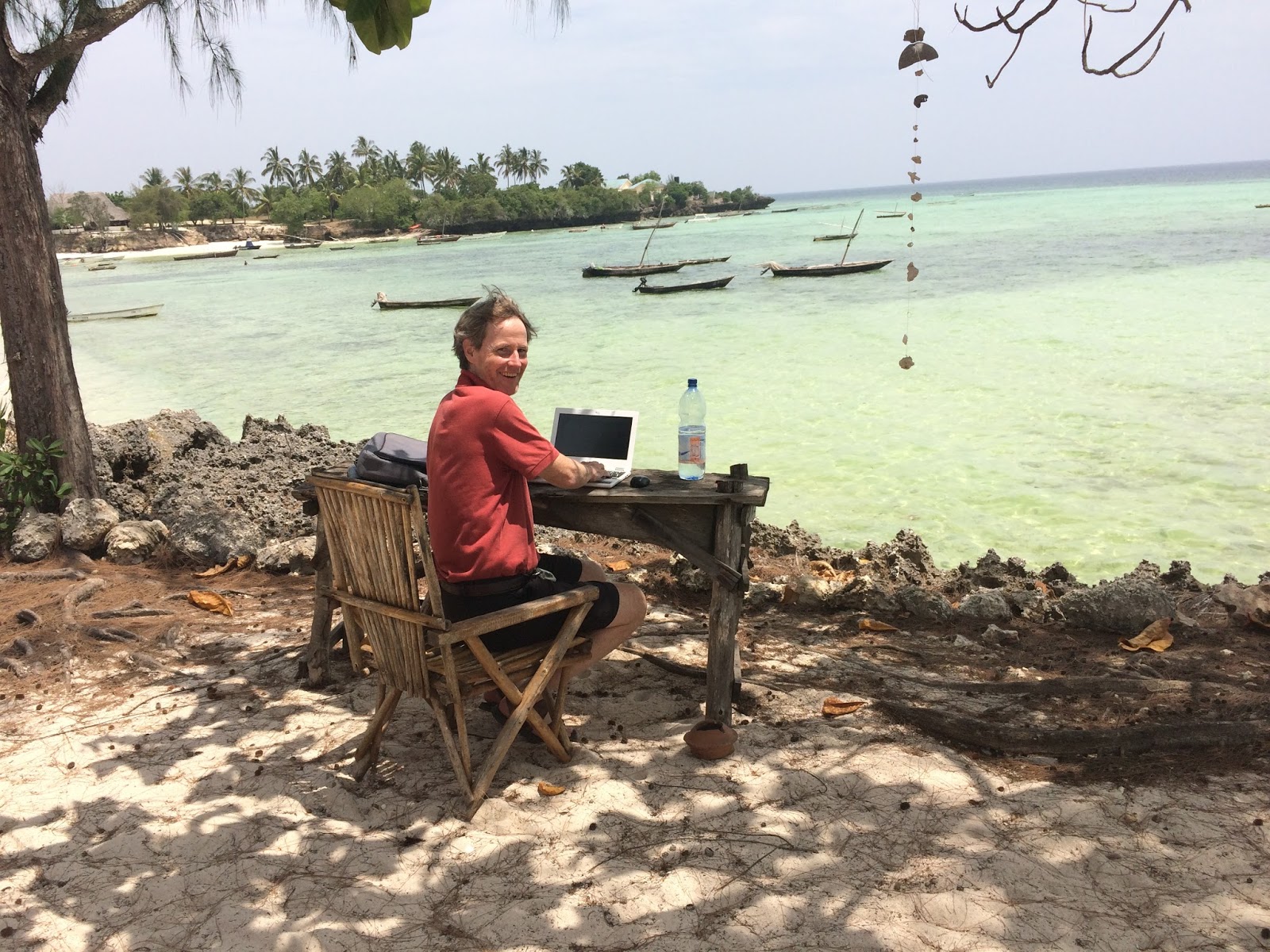
P.S.  At work in my Zanzibar office